
What Is Slow Travel? Philosophy, Origins & More
Learn what is slow travel, its philosophy rooted in the Slow Food movement, and why mindful exploration is the future of conscious travel.


Slow travel asks a simple question with radical implications: what if you experienced a place instead of collecting it? Rather than packing five cities into a week, slow travelers settle into one neighborhood, learn the rhythm of the local market, and let curiosity — not an itinerary — guide their days. This philosophy transforms travel from a consumer activity into a practice of presence, and it is reshaping how discerning explorers move through the world.
Slow Travel: What It Really Means
Slow travel is a mindset that replaces rushed sightseeing with intentional immersion in fewer places. The philosophy draws from the broader Slow Movement, which began with food and migrated into every domain of modern life. At its core, the slow travel meaning centers on depth over breadth: minimum one week per destination, local transport over rental cars, and unstructured time for spontaneous discovery. What is slow travel philosophy if not the belief that presence outweighs distance traveled? The slow travel philosophy rejects the idea that more stamps in a passport equals a richer life. It measures a trip by how deeply you connected — with the landscape, the people, and yourself.

The Origins of Slow Travel
The origins of slow travel trace directly to Carlo Petrini's Slow Food movement in 1980s Italy. In 1986, Petrini organized a protest against McDonald's opening near the Spanish Steps in Rome, sparking a global conversation about what we sacrifice when we choose speed over quality. The Slow Food movement codified the idea that eating should be a deliberate, locally connected experience — and that logic soon spilled into travel. By the early 2000s, travelers were applying the same lens: why race through a country when you could savor it? The conscious travel movement converged around the slow travel manifesto, published by Slow Tourism Italia, which articulates five slow tourism principles: traveling slowly, connecting with local culture, supporting the local economy, respecting the environment, and enjoying the journey itself. This link between slow food movement travel and intentional exploration is the founding story of how slow travel became a global shift in how we move through the world.

Slow Travel vs Sustainable Travel: What's the Difference?
Slow travel differs from sustainable travel in its central concern: pace versus environmental impact. While the two concepts overlap heavily — staying longer in one place inherently reduces per-day carbon emissions — their origins and priorities are distinct.
| Dimension | Slow Travel | Sustainable Travel |
|---|---|---|
| Focus | Pace, intentionality, depth | Environmental and social impact |
| Origin | Slow Food movement (1986) | UNWTO/UNEP sustainability framework (2005) |
| Primary question | Am I moving too fast? | Am I harming this destination? |
| Certification | None formal | GSTC, LEED, Green Key, EarthCheck |
| Typical expression | One-month stay, trains, local immersion | Eco-certified hotels, carbon offsets |
The history of slow travel movement shows it emerged from a philosophical objection to the pace of modern life, while sustainable travel grew from a scientific framework measuring harm. Both matter. Understanding this distinction helps travelers choose the approach that aligns with their values.
Practicing Slow Travel: How to Start
Practicing slow travel begins with one decision: stay longer in fewer places. For a two-week vacation, pick two destinations instead of four. For a long weekend, choose one. The rest follows naturally. Prioritize mindful travel benefits by traveling by train or bicycle when possible — train travel produces up to 96.5 percent fewer CO2 emissions per passenger-kilometer than flying, as of 2025. Support local economies by staying in independently owned guesthouses, eating at family-run restaurants, and booking tours with local guides. Leave buffer time in every day for the unplanned — the cafe you stumble into, the conversation with a shopkeeper, the path that looks worth exploring.

The intentional travel benefits go beyond environmental ones. Travelers who slow down report lower stress, richer cultural understanding, and more meaningful connections with people they meet. In a travel industry where over 60 percent of international visitors to Italy (as of 2025) say they seek authentic, sustainable experiences, the shift toward depth over breadth is no longer niche — it is the direction the conscious traveler is heading.
Is slow travel more expensive?
Not necessarily. Staying longer in one place means fewer flights, apartments with kitchens instead of eating every meal out, and weekly accommodation discounts. On 25 percent of 114 European routes studied in 2024, trains are both cheaper and greener than planes.
What is an example of slow travel?
A slow travel trip might mean ten days in a single Portuguese village — daily walks to the beach, cooking cataplana with a local family, and taking the regional train to a neighboring town for an afternoon. The measure of success is how present you felt, not how many places you saw.
Can you practice slow travel on a short trip?
Yes. Even a three-day weekend can be slow if you stay in one neighborhood, walk instead of taking taxis, and avoid cramming in attractions. The principle is intentionality, not duration.
How is slow travel different from being an expat?
Slow travel is temporary — you stay long enough to connect, but not indefinitely. The goal is immersion without relocation. Expat living implies permanent or semi-permanent residency with different commitments and practicalities.
What are the best destinations for slow travel?
Destinations with strong rail networks, walkable cities, and local food cultures are ideal. Italy, Portugal, Japan, and Switzerland are classic choices, but any place where you can stay rooted in one community and explore on foot or by train qualifies.
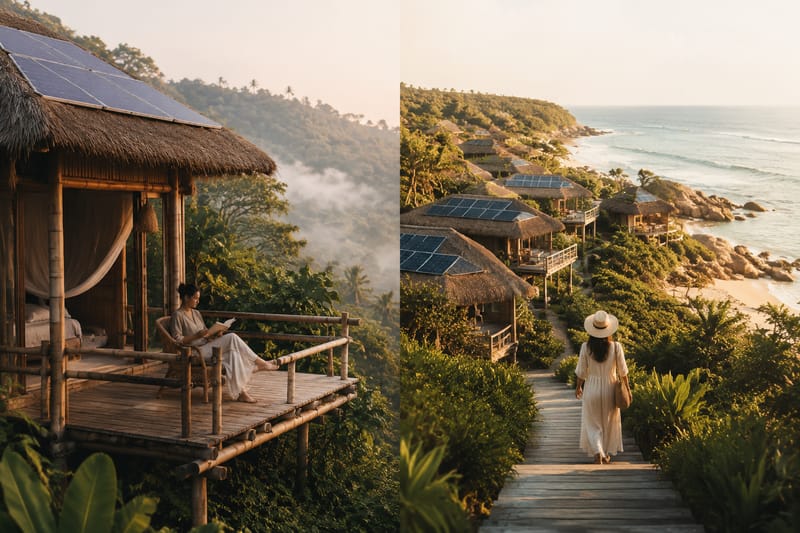
Eco Lodges vs. Eco Resorts: Which Is Right for You?
Discover the best eco lodges and eco resorts for sustainable travel. Explore unique accommodations that prioritize the planet and your comfort.

Slow Travel vs Sustainable Travel: What's the Difference
Not sure if slow travel and sustainable travel are the same? This guide breaks down the key differences and how they work together for better trips.

How to Plan Eco-Friendly Travel Without Sacrificing Comfort
Plan eco-friendly travel without sacrificing comfort. 5 steps covering low-carbon transport, eco-certified stays, and mindful slow itineraries.