
Capsule Wardrobe 2026: The Complete Guide to Building Yours
Build a capsule wardrobe in 2026 with the 3-3-3 rule, seasonal essentials, and trend tips. Fewer pieces, better style, less waste.


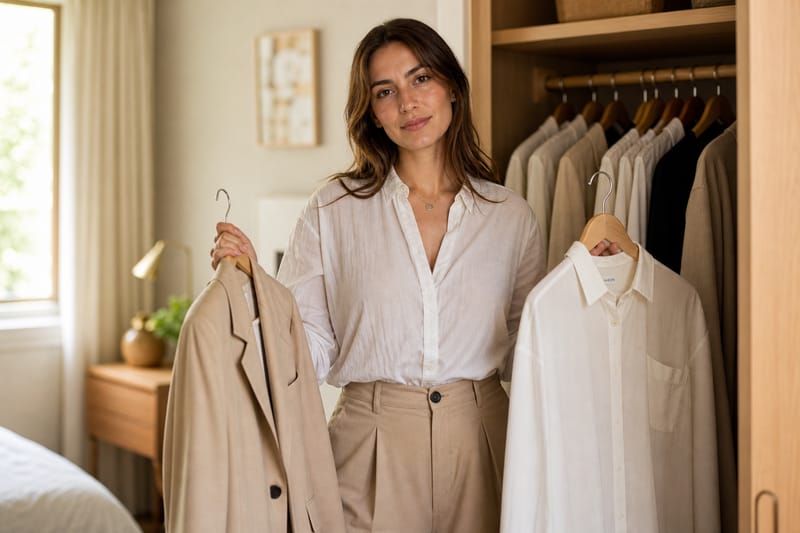
A capsule wardrobe in 2026 is a curated collection of 20 to 40 versatile, high-quality pieces that mix and match into dozens of outfits without daily decision fatigue. The capsule wardrobe 2026 approach — rooted in Susie Faux's 1970s edit philosophy and Donna Karan's landmark "Seven Easy Pieces" collection — has evolved into the most practical framework for women who want fewer, better clothes. This guide walks you through the entire process: from the initial closet audit to building a color palette, adopting the 3-3-3 rule, layering across seasons, and folding in just enough of 2026's trends to keep things current. Use the table of contents to navigate.
For a broader take on this year's style direction, see our 2026 fashion guide for women.

What Is a Capsule Wardrobe and Why Does It Work?
A capsule wardrobe is a small collection of clothing — typically 20 to 40 pieces — where every item pairs with at least three others. The system eliminates the "nothing to wear" problem. Garment wear frequency has declined 36% in 15 years, with the average item worn just 7 to 10 times before being discarded.
The financial logic is just as compelling. A well-built capsule costs more per piece but dramatically less per outfit. Spending $180 on a blazer you wear 60 times yields a cost-per-wear of $3 — versus a $40 fast-fashion blazer worn twice at $20 per wear. Over a year, capsule adherents report spending 30 to 40% less on clothing overall while feeling better dressed.
How to Build a Capsule Wardrobe 2026: The 3-3-3 Rule
Learning how to build a capsule wardrobe starts with the simplest framework: the 3-3-3 rule. Select 3 tops, 3 bottoms, and 3 shoes. That's 9 pieces yielding at least 27 distinct outfits when you account for cross-pairing. It works because it forces ruthless prioritization — you can't hide behind a mountain of "maybe" pieces.
Here are the steps for your first capsule wardrobe — the 3-3-3 rule gives every beginner the structure needed before scaling up:
- Choose your 3 tops. A structured white tee, a silk or modal blouse in a muted tone, and an oversized button-down (blue or chambray works year-round).
- Choose your 3 bottoms. Dark straight-leg denim, tailored wide-leg trousers in a neutral, and a midi skirt — pleated or A-line depending on your frame.
- Choose your 3 shoes. White leather sneakers or minimal trainers, pointed-toe flats or loafers, and a low-heeled sandal or ankle boot depending on season.
The 3-3-3 framework isn't a permanent constraint — it's a training wheel. Once you're comfortable editing down to 9 pieces for a week, expand to a full capsule wardrobe of 25 to 35 pieces that covers work, weekends, and evenings. The goal is a capsule wardrobe women can rely on for every scenario, not just the easy days.

How Do You Build a Color Palette for a Capsule Wardrobe?
A cohesive color palette is the backbone of every successful capsule wardrobe. The formula is straightforward: pick 3 to 4 base neutrals and 2 to 3 accent colors. Base neutrals do the heavy lifting — they pair with everything and anchor your most-worn pieces. Accent colors inject personality through tops, scarves, and accessories.
| Role | Examples | Where to Use |
|---|---|---|
| Base neutrals | Black, navy, camel, charcoal, ivory | Trousers, coats, blazers, bags |
| Accent colors | Burgundy, olive, dusty rose, cobalt | Blouses, knitwear, scarves |
| Metallics (optional) | Gold, silver, brushed bronze | Jewelry, belt buckles, shoe hardware |
The key constraint: every piece you buy must pair with at least two items already in your closet using that palette. If it doesn't, it's not a capsule piece — it's a statement piece, and those belong in a separate "wild card" category (more on that below).
The Closet Audit: Keep, Donate, and Maybe
Before buying anything new, you need to audit what you own. The closet audit takes one to two hours and is the single most important step in building a capsule wardrobe.
The three-pile method:
- Keep: Pieces you've worn in the last 90 days, that fit well, and that match your color palette. These form the nucleus of your capsule wardrobe essentials.
- Donate, sell, or repair: Items you haven't worn in 6 months, don't fit, or need tailoring you'll never actually commission. Americans discard 11.3 million tons of textile waste annually — roughly 81.5 pounds per person. Donating extends a garment's life.
- Maybe: Set these aside in a box. If you don't reach for them in 30 days, they move to the donate pile. No negotiation.
After the audit, you'll likely have 60 to 70% of a working capsule already in your closet. The shopping list that remains is shorter — and more strategic — than you'd expect.

Summer Capsule Wardrobe 2026: Seasonal Essentials
Summer 2026's capsule essentials lean into relaxed tailoring and natural fabrics. The oversized blue cotton shirt is the season's workhorse — it layers over swimsuits, tucks into high-waisted linen trousers, and ties at the waist over midi dresses. A structured white tee in heavyweight cotton (not tissue-thin jersey) gives every outfit a clean foundation.
Summer capsule wardrobe 2026 essentials:
- Oversized blue cotton shirt
- Structured white crew-neck tee
- Simple midi dress in black or navy
- Dark straight-leg denim (yes, even in summer — choose a lighter-weight 10oz fabric)
- Tailored linen trousers in camel or ecru
- Leather slide sandals in tan or cognac
- Minimal white leather sneakers
The capsule wardrobe 2026 summer collection works with 22 to 28 pieces total, including accessories. Fewer pieces mean less packing anxiety for travel, and every item earns its place through repeat wear. A capsule wardrobe 2026 women's summer set also needs a lightweight trench or linen jacket for air-conditioned restaurants and cooler evenings — it doubles as your travel layer on flights.
Building a Capsule Wardrobe 2026 Fall: Seasonal Transitions
Seasonal transitions are where a capsule wardrobe earns its keep. The trick is layering — mixing textures and weights so the same core pieces work across a 15-degree temperature swing. A capsule wardrobe 2026 fall edit typically adds 5 to 8 heavier pieces to your summer base.
Layering formula for fall:
- Base layer: silk camisole or lightweight merino tee
- Mid layer: cashmere crewneck or structured cardigan
- Outer layer: tailored wool coat or leather jacket
A silk camisole under a cashmere crewneck creates warmth without bulk. A denim jacket thrown over a summer midi dress extends that dress into October. The same dark denim trousers that worked with sandals in July pair with ankle boots and a wool coat in November.
A full fall capsule typically runs 30 to 35 pieces — slightly more than summer to accommodate heavier knits and outerwear. The color palette stays the same; you're swapping fabric weights, not reinventing your wardrobe.

Strategic Trend Adoption in 2026
The capsule wardrobe philosophy doesn't mean ignoring trends — it means being selective. In 2026, the approach is to adopt one or two trends through accessories or statement pieces that complement your existing capsule rather than overhaul it.
2026 trends worth integrating:
- Butter yellow as an accent color (works beautifully with navy and ivory bases)
- Sculptural gold earrings and cuffs (replace delicate jewelry for a bolder silhouette)
- Barrel-leg trousers (swap one pair of straight-leg for a wider, curved silhouette)
- Woven leather bags in natural tones (seasonal texture without committing to a new wardrobe)
The rule: a trend piece must pair with at least three existing capsule items. If it only works with one outfit, it's a costume — not a capsule investment. The best capsule wardrobes feel current without feeling trendy, a balance achieved by anchoring 90% of your closet to timeless silhouettes and reserving the remaining 10% for seasonal experimentation.
The Environmental Case for Capsule Wardrobes
Less than 1% of clothing is recycled into new fibers globally. The fashion industry produces roughly 10% of annual carbon emissions — more than international flights and maritime shipping combined. Capsule wardrobes don't solve systemic overproduction, but they shift demand toward fewer, better-made garments.
The math is simple: if every woman in the US bought 15 fewer garments per year and extended the life of existing pieces by just 9 months, the carbon reduction would equal taking 5.7 million cars off the road. Individual purchasing decisions are not the whole answer, but they are a measurable part of it. The ripple effect extends to water usage — producing a single cotton t-shirt requires roughly 2,700 liters of water, enough drinking water for one person for 2.5 years.
Closing
Building a capsule wardrobe in 2026 is less about deprivation and more about precision. The 3-3-3 rule gives you a framework to start small; the color palette keeps everything cohesive; seasonal layering extends your investment across the full year. Americans discard 11.3 million tons of clothing annually, and a capsule wardrobe is the most personal, immediate way to step out of that cycle. Start your capsule wardrobe 2026 journey with a closet audit this weekend — you probably own more of a working wardrobe than you think. The hardest part is deciding to own fewer things; the easiest part is realizing how much better you dress once you do.
Frequently asked
What is the fashion trend for 2026?
The dominant 2026 fashion trends include relaxed tailoring (oversized blazers, wide-leg trousers), butter yellow and warm neutrals as accent colors, and a continued shift toward natural fabrics like linen, cotton, and wool. Quiet luxury — understated, well-made pieces without visible logos — remains the prevailing aesthetic.
What is the 3-3-3 rule for wardrobe?
The 3-3-3 rule selects 3 tops, 3 bottoms, and 3 shoes — 9 total pieces that create at least 27 outfits. It's a simplified entry point into capsule dressing, designed to prove that fewer, well-chosen pieces eliminate decision fatigue and reduce impulse buying.
What is the 5-4-3-2-1 method for a capsule wardrobe?
The 5-4-3-2-1 method expands on the 3-3-3 rule: 5 tops, 4 bottoms, 3 layers (blazer, cardigan, jacket), 2 pairs of shoes, and 1 bag. That's 15 pieces forming a versatile mini-capsule for travel or a starting point for how to build capsule wardrobe collections from scratch.
How many pieces should a 2026 capsule wardrobe have?
A full 2026 capsule wardrobe typically includes 25 to 40 pieces, depending on lifestyle and climate. The core range is 30 to 35, covering work, casual, and evening needs. Accessories (jewelry, scarves, bags) are counted separately and add another 8 to 12 items.
What are the essential colors for a capsule wardrobe?
The standard capsule palette includes 3 to 4 base neutrals (black, navy, camel, ivory) and 2 to 3 accent colors chosen to complement your skin tone and lifestyle. Every new purchase must match at least two existing pieces in your palette.

Womens Fashion Guide: Building a Timeless Wardrobe
A complete womens fashion guide covering 7 essential pieces, sustainable style, and capsule wardrobe strategies for a closet that lasts.
How to Build a Capsule Wardrobe: A Step-by-Step Guide
Learn how to build a capsule wardrobe with 30 to 40 versatile pieces. Covers closet audit, color palettes, essentials, and the 3-3-3 rule.