
Why Clean Beauty Brands Are Reshaping the Skincare Industry
Clean beauty brands command a $10B market with 16.8% CAGR growth. Retailer standards and consumer demand are making clean beauty a permanent shift.
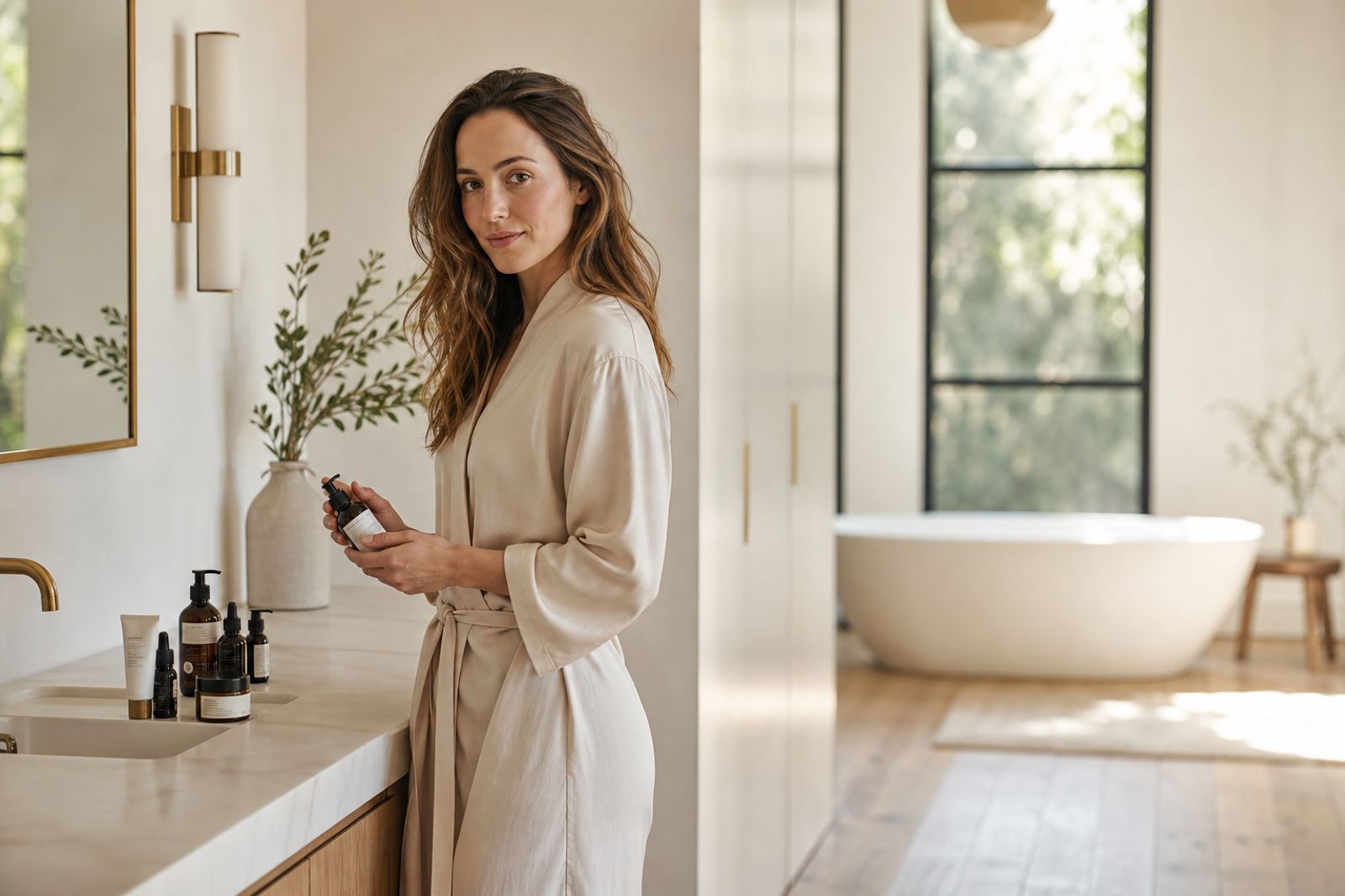
Woman examining clean skincare product labels at a sunlit bathroom vanity with warm natural light

Clean beauty brands have moved from the margins of the beauty industry to its center of gravity in under a decade — and the numbers, the infrastructure, and the consumer behavior all point to a structural shift, not a passing trend. The question is no longer whether clean beauty matters but how the movement is reshaping everything from ingredient sourcing to retail floor plans to how the clean beauty industry defines a luxury skincare product.
See our complete guide to organic skincare for the full picture on certifications, ingredients, and building a routine.
Clean Beauty Brands Command a $10 Billion Market and It's Only Accelerating
Clean beauty brands generated $10.49 billion in 2025 and project toward $35.30 billion by 2033 — a rate tripling the broader beauty market. Three structural forces anchor this trajectory: demographic alignment, purchase-behavior hardening, and retail infrastructure investment that shows no signs of retreat.
The demographic story carries particular weight. Sixty-eight percent of beauty consumers now actively seek clean ingredients in their purchases, with demand strongest among the 28-to-45 age cohort as of 2026 — precisely the demographic with the highest discretionary skincare spending. Paraben-free products alone are growing 80 percent faster than the overall beauty market as of 2026, a delta that signals preference hardening rather than experimentation. When consumers switch to clean formulations, they tend to stay — repeat purchase rates in the clean beauty industry outstrip conventional beauty by a measurable margin.

Retailers are not waiting to see if this momentum holds. Sephora launched its Clean at Sephora program in 2018 and has expanded it every year since. Ulta's Conscious Beauty initiative now includes a dedicated clean ingredients filter shaping how millions of shoppers browse daily. The Detox Market has grown from a single Los Angeles storefront into a multi-channel clean beauty destination. These are not boutique experiments — they represent billions in retail square footage and digital shelf space permanently reallocated toward top clean beauty brands.
Clean Beauty Retailers Have Become the De Facto Regulators
Clean beauty retailers like Credo Beauty maintain ingredient exclusion lists exceeding 2,700 substances as of 2026, creating private standards where public regulation has lagged. Regulatory agencies have not defined the term "clean beauty" — no law in the United States or the European Union establishes what the word means on a product label. That vacuum might have produced chaos. Instead, it produced a retailer-led standards regime that is, in practice, more stringent than most government cosmetic regulations anywhere in the world.
Credo Beauty bans every ingredient on its exclusion list across its entire catalog — a brand cannot sell a Credo-compliant product on one shelf and a non-compliant product on another. The Environmental Working Group's EWG Verified program has certified 1,219 skincare products as of 2026, applying a standard requiring full ingredient transparency, banning over 2,700 substances, and mandating good manufacturing practices. MADE SAFE screens entire formulas for bioaccumulation, persistence, and ecosystem harm. NATRUE, the European certification body, requires 100 percent natural origin for its highest tier as of 2026 — a standard that precludes the synthetic shortcuts conventional beauty relies on.
Retailer or Certifier: Credo Beauty (as of 2026) Banned Ingredients: 2,700+ Scope: Full catalog Year Established: 2014 ──────────────────────────────────────── Retailer or Certifier: EWG Verified (as of 2026) Banned Ingredients: 2,700+ Scope: 1,219 certified products Year Established: 2015 ──────────────────────────────────────── Retailer or Certifier: Sephora Clean (as of 2026) Banned Ingredients: 50+ categories Scope: Designated seal Year Established: 2018 ──────────────────────────────────────── Retailer or Certifier: The Detox Market (as of 2026) Banned Ingredients: 1,000+ Scope: Full catalog Year Established: 2010 ──────────────────────────────────────── Retailer or Certifier: MADE SAFE (as of 2026) Banned Ingredients: Full formula screening Scope: Third-party verified Year Established: 2015

The market power of private standards is now measurable in reformulation budgets. Brands re-engineer entire product lines specifically to meet Credo or EWG requirements because the shelf space and consumer trust unlocked outweigh the research and development cost. A product that cannot carry the EWG Verified mark or sit on a Credo shelf faces a narrowing distribution funnel — these standards have become gatekeepers not through legislation but through consumer expectation and retail access, a faster mechanism than any regulatory timeline could deliver.
Is the Clean Beauty Movement Built to Last — or a Greenwashed Facade?
Is the clean beauty movement a permanent restructuring of the industry or temporary marketing — three structural indicators point toward lasting change rather than a cycle destined to reverse. The first indicator is regulatory momentum moving in only one direction. The European Union continues to tighten cosmetic ingredient restrictions on a rolling basis, and individual US states led by California and Washington are passing chemical restrictions that directly affect beauty formulations. Brands that preemptively reformulate to cleaner standards gain a competitive moat — already compliant while competitors scramble through multi-year reformulation cycles.
The second indicator is the convergence of clean formulation and clinical efficacy, a development that neutralizes the most durable criticism of early clean beauty products. Brands like True Botanicals and Biossance have invested heavily in clinical testing of clean formulations, producing performance data that matches or exceeds conventional benchmarks. The Allure Best of Beauty Awards now include dedicated clean beauty winner categories — not as a consolation bracket but because the products compete and win on measurable merit against any formulation approach.
The third indicator is the mass-market embrace, and mass-market brands do not invest in category infrastructure for temporary trends. CoverGirl and Maybelline have launched clean-labeled lines that sit alongside their legacy products on drugstore shelves, and these moves matter precisely because they are unglamorous. When the brands defining the center of the American beauty market build dedicated clean sub-brands, they are betting on permanence with real supply-chain capital.

The critique that clean beauty is a marketing invention — a greenwashed facade — is itself a signal of the movement's maturity. Every structural industry shift generates a counter-narrative loud enough to be heard, and the fact that this counter-narrative has gained traction indicates the shift is substantial enough to threaten incumbents. What the critique correctly identifies is that the absence of a legal definition creates genuine greenwashing risk, and brands have exploited the ambiguity. What it overlooks is that the clean beauty movement is actively solving the definition problem through private standards, consumer education, and retailer gatekeeping — a mechanism that adapts faster than legislation and has already built more enforcement infrastructure than most regulatory bodies possess.
Where This Lands Us
Clean beauty began as a consumer-led rejection of opaque formulations and ended up restructuring the entire beauty value chain — from ingredient sourcing to retail shelf allocation to how luxury is defined. The absence of a legal definition, far from dooming the movement to irrelevance, created the conditions for a faster and more adaptive standards regime driven by retailers and certifiers rather than legislators. The brands treating clean beauty as a permanent structural shift rather than a positioning tactic are writing the next decade of the industry. Everyone else will be catching up from behind.
What does 'clean beauty' actually mean — and who decides?
Clean beauty means products formulated without ingredients suspected of being harmful, but the term lacks any legal definition. Credo Beauty and EWG Verified effectively decide the industry's working definition through ingredient exclusion lists that carry more market weight than any regulatory standard.
How are clean beauty brands different from natural or organic brands?
Clean beauty focuses on safety — excluding potentially harmful ingredients regardless of origin. Natural beauty means plant-derived or mineral-sourced ingredients but carries no regulation on percentage requirements. Organic beauty requires agricultural certification through programs like USDA Organic, which governs farming practices rather than formulation safety. A product can be natural without being clean and clean without being organic.
Do clean beauty products actually work as well as conventional ones?
Leading clean beauty brands including True Botanicals and Biossance now invest in clinical testing that produces efficacy data matching or exceeding conventional benchmarks. The convergence of clean formulation with clinical science has closed the performance gap that defined early clean beauty, and dedicated clean categories in major beauty awards reflect competitive parity.
Which certifications actually matter — EWG, MADE SAFE, or NATRUE?
EWG Verified carries the most retail market weight in the United States with 1,219 certified products and a 2,700-ingredient ban list. MADE SAFE screens for broader environmental impact including bioaccumulation and ecosystem harm. NATRUE is the leading European standard requiring 100 percent natural origin at its highest tier. Each certification addresses a different dimension — ingredient safety, ecological safety, and natural origin, respectively.
Is clean beauty just a marketing trend that will fade?
The clean beauty movement has built permanent infrastructure — retailer programs, third-party certifications, reformulated supply chains, and mass-market adoption — that cannot be unwound quickly. The 16.8 percent CAGR projection through 2033, regulatory momentum in the EU and US states, and the entry of mainstream brands all signal permanence over trend.
Clean Skincare Review: 5 Brands Tested for 30 Days
Honest 30-day trial of 5 clean skincare lines: Tata Harper, True Botanicals, ILIA, Biossance & OSEA. Real results, real prices, no affiliate fluff.
What Is Clean Beauty Skincare? A Complete Beginner's Guide
Learn what clean beauty skincare means, how it differs from natural and organic, and which certifications to trust when building a clean routine.