
Workplace Nails: Elevate Your Office Style in 2026
Discover the latest trends in workplace nails for a polished, professional look that balances style and etiquette.


The old "nude or nothing" standard for office nails is dead. In 2026, professional nails are not about hiding polish but about making intentional, context-aware choices that signal competence and self-possession. Workplace nails have evolved from a uniform of beige compliance into a quiet form of self-expression — one that balances personal style with respect for the room you walk into. The question is no longer whether you can wear colour to the office, but which colours, finishes, and lengths communicate the unspoken message you want to send.
For a complete overview of nail trends and inspiration, explore our Complete Guide to Nail Art Ideas.
The Unspoken Rules of Professional Nails Have Shifted
The unspoken rules of professional nails in 2026 reward context-awareness over blanket compliance. Corporate nail etiquette has shifted dramatically — a national reader poll found that 31 percent (in 2026) of professionals believe any solid colour is appropriate for a conservative office as long as it is not chipped, a sharp rise from the 26 percent who held that view in 2009. The key insight for conservative office nails is that maintenance, not colour, has become the true professional non-negotiable. Chipped polish, overgrown cuticles, and visible wear undermine workplace authority faster than any shade choice ever could. The near-universal rejection of sparkles and patterns remains: just 1 percent (in 2026) of respondents found them acceptable, so the boundary between safe and risky is still clear.

Industry Context Shapes Office Appropriate Nail Choices
Industry context determines what reads as office appropriate nails more than any universal colour chart. What passes for professional nails for work in finance and law would be unnecessarily conservative in a creative agency, and what flies at a remote startup would raise questions in a law firm. The clearest framework for work appropriate nails divides workplaces into four categories. In finance and law — the most conservative sectors — the palette narrows to nude, blush, classic red, and deep burgundy in autumn and winter. Length stays short, at or above the fingertip — finding the right nail shape is equally important for a polished look. In creative fields such as advertising, media, and design, muted colour gains ground: muted green, navy, and burgundy pass as professional without raising eyebrows. For remote and hybrid workers, the most important audience is the camera lens. Hands appear constantly during video calls — typing, gesturing, holding coffee — and the camera amplifies every imperfection. Clean, camera-ready nails with a sheer or milky finish read as polished without distracting from the conversation. The rule that cuts across every sector is the distinction between client-facing and internal roles. Client-facing professionals should narrow their choices by one full notch of conservatism from whatever their industry baseline allows.
| Sector | Acceptable colours | Length limit | Special considerations |
|---|---|---|---|
| Finance / Law | Nude, blush, classic red, deep burgundy | At or above fingertip | No 3D art, no glitter, no sparkle |
| Creative / Media | Muted greens, navy, burgundy, sheer shades | Medium (slightly past fingertip) | Patterns acceptable in conservative tones |
| Remote / Hybrid | Sheer, milky, ballet pink, mocha brown | Any (camera-readable) | Clean cuticles, no chips — camera amplifies flaws |
| Healthcare | Sheer or no polish | Short, rounded | Follow facility hygiene policy |
What Are the Best Work Appropriate Nail Colors for 2026?
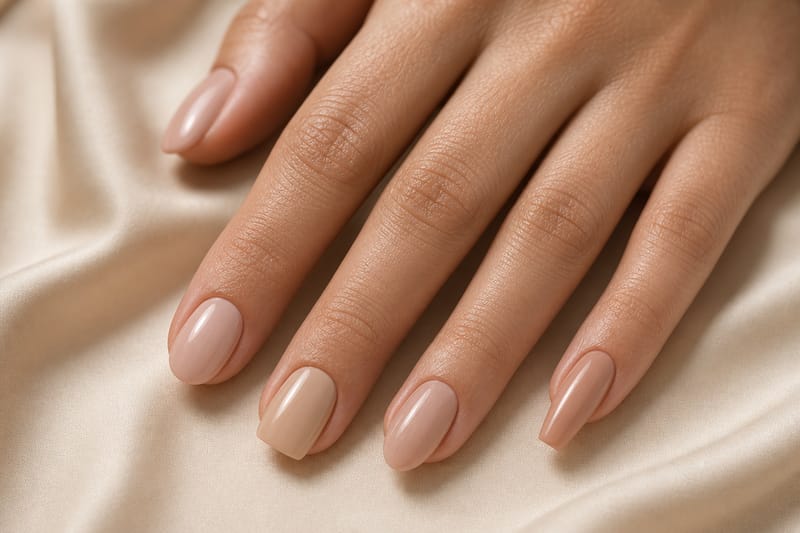
What qualifies as work appropriate nail colors in 2026 has expanded beyond the classic nude to include three major trend families. The first is sheer smoke and milky finishes — translucent, jelly-like colours that let the natural nail peek through. These finishes pair naturally with the clean-girl aesthetic and work across every industry from finance to fashion. When considering office nail colors, these sheer options are the safest way to introduce personality without breaking conservative dress codes. The second is mocha brown, which entered the professional mainstream after Pantone named Mocha Mousse its 2025 Colour of the Year and the colour carried into 2026 as a staple. Brown nails offer a sophisticated alternative to beige and nude, reading as warm, intentional, and quietly confident. The third is the micro-tip French manicure — a hair-thin line of white or off-white on a sheer base that is nearly invisible at first glance but unmistakably polished up close. In 2026, this is the leading office-nail trend across all sectors: it passes every conservative dress code while still feeling modern and considered. The best nail colors for work are ultimately those that balance personal taste with the room you are in — a calculus that becomes intuitive once you understand the framework.

Frequently asked
What nail colors are appropriate for a conservative office?
Nude, soft pink, classic red, and deep burgundy remain the safest choices for conservative law and finance settings. Solid colours only — no patterns, sparkles, or 3D elements are acceptable.
Can you wear dark nail polish to a law firm or finance job?
Deep burgundy and dark berry shades pass in autumn and winter, but black, navy, and very dark greens may read as too edgy for formal client meetings. When in doubt, stick to the muted end of the spectrum.
Are sheer and milky nail finishes acceptable for the office?
Yes — sheer and milky finishes are among the most office-appropriate options in 2026. They read as polished and professional while allowing a subtle hint of personality through the translucent colour.
What nail length is considered professional for corporate environments?
Short to medium length, at or above the fingertip, is standard across conservative industries. Nails longer than a quarter-inch past the fingertip may read as impractical or distracting in client-facing roles.
How do nail standards differ between client-facing and internal roles?
Client-facing professionals should be one notch more conservative than their industry baseline. If a creative agency allows muted greens and burgundy, client-facing staff may want to stick with blush and nude for external meetings.
Nail Types and Shapes: Complete Guide to Your Perfect Match
Discover which nail types and shapes flatter your hands most. From squoval to stiletto, find your match by hand anatomy, nail strength, and lifestyle.

The Perfect Nail Care Routine: Step-by-Step Guide
Discover the ideal nail care routine for healthy nails. Follow our step-by-step guide for beautiful, strong nails.